Dr. Metablog

Dr. Metablog is the nom de blague of Vivian de St. Vrain, the pen name of a resident of the mountain west who writes about language, books, politics, or whatever else comes to mind. Under the name Otto Onions (Oh NIGH uns), Vivian de St. Vrain is the author of “The Big Book of False Etymologies” (Oxford, 1978) and, writing as Amber Feldhammer, is editor of the classic anthology of confessional poetry, “My Underwear” (Virago, 1997).

DR. METABLOG’S
GREATEST HITS


  • The coronavirus has been sorely inhibiting. It's no fun for me to keep a distance from members of my family with whom I'm not podded up. But there's a benefit, because for a year now I haven't had a single anxiety attack over what a European acquaintance calls "the dreaded American hug."  My needs for acknowledging friends and acquaintances have been well satisfied by an occasional and discreet elbow bump.  

    I'm not a hugger either by nature or by training — my family of origin was, well, whatever is the diametrical opposite of "touchy?"

    When did the hug creep into our lives? I suspect it had its origins in late 60s early 70s counter-culture. At least in my social circles — that is. For all I know, the Brewsters might have regularly hugged the Bradfords back there in Mayflower days. Although not without massive attacks of disabling guilt.

    When males want to hug me, I tend to shrink backwards. I don't want to give offense, so I offer as much hug as my hug-averse nature can tolerate. With women it's much more difficult — because of the bosom problem. Too quick an embrace and you're unsociable, but one that lasts a second too long and you're a pervert. The best solution, I've found, is the sideways hug — just throw an arm around the lady's shoulder and briefly touch your right ribcase to her left. And then beat a retreat.

    Let's bring back the straight-on traditional handshake. It's sensible and proven. And for goodness sake, no kissing each other's cheeks "like them foreigners do."

  • A Scots Quair

    I've given over the last week or ten days to Lewis Grassic Gibbon's A Scots Quair and I'm very pleased to have done so. And I'm embarrassed that I've only now read this strange brooding wondrous series of novels. How could I not have known? For those equally as ignorant as I, the Quair is a trilogy — Sunset Song (1932), Cloud Howe (1933) and Grey Granite (1934). Together they tell the story of Christine Guthrie from childhood — about the turn of the century — through the years of the Great Depression. I can't remember reading a piece of fiction that has so thoroughly engaged me, or encountering  a fictional character so fully realized as Chris Guthrie Tavendale Colquhoun Ogilvie.

    Here's a picture of Gibbon (birth name: James Leslie Mitchell) who died at age 34 from a botched surgery.

    The novels do for the northeast corner of Scotland what Thomas Hardy did for the southwest of England. Gibbon's corner of Scotland is traditional agrarian society beset by doctrinaire religion, industrialization, war, and the Great Depression. The novels range from extremely brutal to marvelously lyrical. They are not without defect: sometimes too long, often too preachy. Occasionally, I felt that I was being treated to a Scottish version of "orientalism": Scotism, perhaps. The books want condensation, editing; sometimes I felt that I was reading a first draft — but Gibbon wrote fifteen books in seven years, so signs of haste are inevitable. Gibbon might be called a local colorist or a social realist, but he's much more. His feel for the landscape and for history is unparalleled.

    In subject matter and tone, A Scots Quair reminds me most of Halldor Laxness's great Icelandic novel, Independent People. It's also like one of Hardy's Wessex novels, but funnier, more playful, and yes, more sensual. There are stream-of-consciousness speeches that recall Faulkner and passages that might have been written by James Joyce (not the Joyce of Ulysses but the Joyce of Portrait).  A much neglected masterpiece. 

  • For two days, I kept track of the initials that I needed to know to make sense of the world. Here they are, all familiar, no doubt: HOA,, MRI, IED, CNN, EPA, FDA, DNA, OMB, ED, NBA, COVID, GPS, AWOL, PTSD, TCM, WTF, BPL, TIA, ETA, MST. Just two days. IK that there's a part of the brain that stores nouns; I wonder if humans will evolve to develop an area to store acronyms. 

  • It's been a rough year what with the madman president and the covid pandemic. And also deaths and diseases among my close friends. I have at least ten male friends who've lost their wives after long marriages. Some have bounced back, some will never get over the grief. At the beginning of 2020, I made a joke:  "it's going to be the year of the ophthalmologist." It turned out to be the year of the thanatologist.  

    Nevertheless, I can honestly say that my dominant mood is one of gratitude.

    Grateful that I've lived a long life, mostly healthily, and that my children and grandchildren are thriving. I'm not rich, but I've never missed a meal for want of cash. 

    When my father was my age, he was crippled with arthritis and he was widowed, living a sad solitary life. I take long walks in the mountains and have a new love in my life.

    As of today, 1.1 million Americans have been vaccinated against the virus. There will be errors and disruptions and scandals, but in a few months we'll be mostly back to normal. And I believe and hope that our wonderful country will survive this accidental lunatic presidency.

  • Female (1933)

    Here's a colorized illustration of Ruth Chatterton as Alison Drake in the "pre code" romance Female (1933).   
     
    Female (1933) | flashyak
    Although she's surrounded by a bunch of official looking executives, she runs the show. Miss Drake owns and manages factory that manufactures automobiles. She's in a male preserve — it's not a cosmetic factory or something more traditionally feminine. And she loves the work and the power.
     
    The film might have been called Alison Drake but no, it's Female — and therefore claims to describe not just one individual woman but an entire gender. Does it? At best, the film is mighty confused — and at worst, reactionary in the extreme.
     
    In the first half of the film, Alison Drake is not only an extremely competent executive, but she's also sexually liberated. It's her habit to bring home attractive men, seduce them, and, if they get the least bit soppy, transfer them to the Montreal office. She's one happy –although heartless — "cougar." Then she meets her match in the person of young handsome (before he grew that silly little mustache) George Brent, who responds to her advances by saying, "I was hired as an engineer, not as a gigolo."  All of a sudden, Miss Drake goes all weak in the knees, falls in love, and decides to marry the man. She puts him in charge of the factory and plans to stay home in order to achieve the apotheosis of femininity by having "nine children."
     
    The disappointing ending seems to be pasted on rather than organic. Many a film in the Code era set out to challenge the "tune of the time" but threw in the conventional towel because of the Hays Office. Female is disappointing because it voluntarily chooses to go all squishy when it wasn't necessary.
     
    Here is Ruth Chatterton on her submissive and symbolic back.
     
    Female (1933) - IMDb
  • Pairings

    "Kith and kin" is an excellent example of a "pairing" — sometimes called a "coordinate pair." A pairing is a linguistic event in which two words join to produce a single meaning.

    "Kith" has no independent existence nowadays and only exists as an element of the pair. "Kith and kin" means "family." Originally, back then, "kith" meant "known" and therefore signified "friends." "Kith and kin" was "friends and relatives." No longer; now it means "family and family." "Time and tide" is another fine pairing; "tide" meant "time" centuries before it came to refer to the moony fluctuation of the seas, although its older meaning survives in "eventide," "Yuletide," and similar words. Now "time and tide" seems to evoke the inevitability of both clock and waves — both of them joined to wait for no man. "Kit and kaboodle" is also a lovely pairing, because "kaboodle" lacks independent existence. It may derive from "boodle' — a thief's bundle — with the "ka" added just for the fun of it. "Dribs and drabs" is more obscure in origin and may not be a true pairing. "Dribs" is probably a variant of "drip" but "drab" was in times past not a small amount of something or other, but an untidy or unchaste woman. It's possible that "dribs and drabs," now a rather neat pairing, is better thought of as a reduplicative like mumbo-jumbo or hoity-toity. "Nook and cranny" is a pairing in which both elements survive independently; "nook" originally a corner of a room, and "cranny" a narrow space in which a brown recluse might hide. When someone or something grows by leaps and bounds, it's hard to tell which is the leap and which the bound. The same with "hot and bothered" — the two words simply reinforce each other. Similarly, a person might want to "pick and choose" between alternatives, but to do so requires only one action. "Flotsam and jetsam" is an amusing pairing of uncertain origin. It is often thought that flotsam lies on the surface of the water and jetsam is thrown into it, but such a definition might be merely a folk etymology derived from the words "float" and "jettison." A "hoot and a holler" both refer to shouting, but now they mean "shouting distance." "Stuff and nonsense" is obvious, but what sort of "stuff" is nonsensical? Perhaps it's the very vagueness of "stuff" that it allows it to pair up and reinforce "nonsense." "Alack and alas" is a weary but euphonious pair. "Wrack and ruin" becomes more transparent when it's remembered that wrack is a variant  form of wreck — as "beck and call" becomes clearer when it is recalled that "beck" is a foreshortened version of "beckon." The cry in "hue and cry" is obvious; the hue is thought to derive from the OF verb huer (shout). 

    Null and void, bag and baggage, prim and proper, vim and vigor, are self-explanatory.

    Bits and pieces are sometimes called odds and ends. That's the long and the short of it. Jot and tittle have been thoroughly researched and explicated here.

    Is "footloose and fancy-free" a pairing. Yes, I think so. An energetic and imaginative pairing. 

  • Once again, I was lost, this time in a strange city — apparently, I was trying to drive from somewhere down south all the way to Vermont.  We park the car and my companion (a guy totally unknown to me, by the way) asks a traffic cop the name of the city at which we've arrived. The policeman says to my friend, "ay, ya" and my friend says to me, and I quote this lunatic absurdity absolutely verbatim, no embroidery whatsoever, 'He says we're in  ay-ya, which is West Indian for New Brunswick, New Jersey."  

    "West Indian for New Brunswick, New Jersey?"  Goodness gracious, is that creative, or what? Another brilliant achievement of my dreamatorium.

  • Friends, relatives, and stray internet pilgrims know that Dr. Metablog, aka Vivian de St. Vrain, etc. is a "replacement child" and has written about it in the blogpost Susan P. and also in brief remarks on Louis Aggasiz, Edward Gibbon, Thornton Wilder, and a guy from the old neighborhood.

    Now, I'm happy to say, there's a new website devoted to the study of Replacement Children. You can access it here, and learn about Mark Twain, Frida Kahlo, Vincent van Gogh, Elvis Presley, and other famous and not-so-famous "replacements." It's worth a visit.  

  • Along with everyone of my generation, I've been worrying about my deteriorating memory. There are these horrible moments. I stand in front of the open refrigerator, wondering what I'm doing there and for what I'm searching. Or I go the market and then forget to bring the groceries in from the car — that sort of thing. Is it normal deterioration or is it pathological?
     
    So I'm happy to bring some good news — no, remarkable news from the memory front.
     
    A couple of nights ago, Miss Reynolds and I watched the worst movie we've seen in many a year. It's called Johnny Guitar, a it's a "western" perpetrated in 1954. It's an unholy mess of pretentious but incoherent plot, absurd characters, goofy dialogue and atrocious acting. We watched it right to the end because it was so bad bad bad that it became amusing. The film is so beyond crappy that it has been praised as authentically American by both Godard and Truffaut.
     
    About three-quarters of the way through, I said to Miss Reynolds that the actor who played the villainous "Dancin' Kid" — his name, no joke, and he actually performs a few steps with Mercedes McCambridge, who if overacting were a crime, would have served a life sentence in a supermax facility — that the actor, billed as "Scott Brady" looked a lot like Lawrence Tierney, a no-longer-remembered "heavy" who had starred in "Born to Kill" (1947), which we had watched a couple of months ago.
     
    Let me burnish this feat. I proposed that so-called "Scott Brady" resembled Lawrence Tierney. What a remarkable and daring assertion! 
     
    So after Johnny Guitar came to its ludicrous conclusion, bullets flying everywhere, I looked up so-called "Scott Brady," the "Dancin' Kid," on Wikipedia  and discovered that his birth name was Gerard Tierney and that he was indeed the younger brother of Lawrence Tierney. 
     
    I got to say I spent a few minutes crowing. I mean, really, noticing the resemblance and recalling the name of an obscure actor whom we had hardly noticed months ago — what a coup! What a feat! I could hear the hallelujahs ring throughout our valley.
     
    I didn't think that Miss Reynolds was sufficiently effusive in praise of my achievement — although she did her best — so I went to the window, opened it and shouted into the street, very loud, these words: "In Johnny Guitar, Scott Brady is Lawrence Tierney's younger brother Gerard." No doubt putting the Governor's security detail on Code Red alert.
     
    After a few minutes, I wanted to do it again, but Miss R. talked me down.
     
    The next day, I bragged to my children and their spouses about my achievement. One of my daughters-in-law, CKNC, wrote back that on reading my news, she went to her front door, opened it, and shouted, "My father-in-law knew that in Johnny Guitar, the actor Scott Brady is Lawrence Tierney's younger brother Gerard."  An entirely appropriate and measured response on her part, in my opinion.
     
    My point is that a guy who can identify Lawrence Tierney's brother shouldn't worry about brain decay for at least a month or two. 
     
    I don't know in what part of the brain information about Lawrence Tierney is stored. Certainly not the part that doesn't let you know why you're peering into the open refrigerator.  
     
    I should also point out that I've recently received confirmation of the excellence of my amygdalae:   https://www.drmetablog.com/2020/11/spider.html
     
    So there's hope.
     
    [December 18:  Last night we watched, on TCM of course, a movie called Passion Flower (1930), an interesting tale of love and marriage and adultery and reconciliation and compromise. Definitely pre-Code. At one point, there's a party scene.  A very young man says his good-byes.  Both Ms. R and I immediately said, "that's a familiar face. Who is he?" And I said, "his voice sounds a lot like Ray Milland's." Later that evening we look it up on Wiki. Here's the news: "first screen appearance of Ray Milland, uncredited." 
     
    Another astonishing feat — this time of voice recognition. The old guy still has it, some of the time.]
  • Brown Recluse

    Last night, I was lying in bed comfortably reading Michael Kulikowski's excellent new book on the last years of the Roman Empire. I was concentrating very hard, because it's difficult for me to retain the decisions made at Nicaea in 325. I can read a paragraph about the Arian or some other "heresy" and five minutes later I can't remember who was on what side, or why it matters, except that those on the wrong side were liable to be burnt alive. What part of the brain is supposed to retain this stuff?  In any case, I was lost in the book, quite content, comfortable — supportive mattress, soft pillow and all that — while, unbeknownst to me, a spider was making its way up the backside of the book cover. Why? Where did it come from?  All I know is that it rounded the bend, so to speak, nonchalantly strolling into view at the very top of the verso page.

    Immediately the most primitive part of my brain was activated, I elevated out of the bed like some sort of 1950s cartoon character, hovered for a second or two, and then found myself on the floor, frantically flapping the sheets and blankets, searching for the offending arachnid. Get him before he gets me!

    If I understand what happened, the amygdala, the part of the brain that's in charge of fear, governed my actions. The amygdala has been producing fear and flight responses long before it came to be incorporated into homo sapiens

    After a few minutes we (I had called in auxiliaries) located the offending guy, and he's now sitting on my desk in a tightly sealed Bonne Maman jam jar.

    what does the brown recluse spider look like?

    I think it's a brown recluse. It sure looks like one. The color and shape are right out of the official catalog. According to the authorities, the only foolproof way to ascertain if it's a brown recluse is to count its eyes — six rather than the usual spidery eight. But anyone who thinks that I'm going to get close enough to this spider to count its eyes has another think coming. Brown recluses are rare in our part of the world, but they're not unknown. My book came via interlibrary loan from Laramie, Wyoming; perhaps the spider came along for the ride.

    Why be frightened of a brown recluse the size of a quarter, legs extended?  "Brown recluse bites can inflict significant or even life-threatening damage. Bites may cause severe pain, ulcers, fever, chills, nausea, joint pain, or even seizures."  Also, necrosis. Scars from necrotic flesh can last a lifetime. A friend of a friend lost a few months of his life and a hunk of gluteus maximus to a bite on the butt. 

    The spider is quite active now in its new home — the jam jar. It's a beautifully engineered little creature and very industrious, unceasing in its determination to find the way out. I admire it, behind glass, and I probably share a lot of DNA with it — though it's hard to feel a close kinship. 

    The "take-away": even though some parts of my brain have deteriorated, my amygdalae are in splendid working order.

  • [March, 2012]  Well, maybe not readers. Page-viewers. But did they view closely?  Did they savor the wit and learning?  Did they browse?  Or did they merely Ctrl-C and plagiarize a few sentences for that high school essay which is due tomorrow morning?

    Still, 100,000 is a good round number. Some bloggers, alas, have as many visitors in a single day. 

    [November 25, 2020: 315,000 visitors, or viewers, or readers, or whatever they're called. And counting.]

  • What factors led a city boy, age 28, to purchase a rural property where he has now passed fifty glorious summers? Where he is as happy as a lark with a packet of seeds and a pruner, rake, and hoe.

    It all began with my father's love for his backyard garden. "Have you ever seen a more perfect flower than this?" he would ask, pointing me to one of his splendid hybrid teas. During the growing season, he'd come home from work at 6:00 p.m. on the dot, hurry through supper, change out of his lawyer suit into his old clothes, and get to work. I never saw him more contented. He cultivated his 30' by 40' plot with the assiduity of a Javanese terrace farmer. I watched him carefully and participated when he would let me. I studied, with the concentrated attention of childhood, the growth habits of snapdragons, sweet peas, and marigolds. Then one year I was allotted a square foot of space, right next to the dwarf peach, in which to plant seeds of my choice.  I chose a pumpkin, a vine that did not recognize boundaries, and produced two astonishingly large fruits. The die was cast.

    There was also my maternal grandmother Sonia, originally a country girl, who never bought an orange or a grapefruit but that she planted its seeds on the window sill — in one of those old wooden Philadelphia cream cheese boxes. Her tiny apartment had a pleasant hothouse-y odor. She loved her seedlings.

    And then there were the three summers ('47, '48, '49) which my family spent on Makamah Beach near Northport on the Long Island Sound. It was my original rural experience, and the earliest hint that there were places other than concrete and chain-link-fence Flatbush. It was the first time in my life that I felt at ease in the landscape.

    I must not forget the Brooklyn Botanic Garden, where I spent many a happy hour. I remember in particular its famous Japanese garden. There was also a bank of colorful bottlebrush buckeyes that caught my youthful fancy. Many years later, I tried to reproduce that bloom in my Vermont garden. The curve and slope of the land were ideal, but the plant itself was not for our subarctic winters. The buckeye has survived, barely, for forty years now and has never produced a single flower, nor ever will.

    It was at the BBG that I learned that gardening was not just about growing the biggest pumpkin — it was about aesthetics and design. I started to read about the history of gardens and whenever I traveled I detoured to visit the great examples: the Huntington, Dunbarton Oaks, the Winterthur in Delaware. And scores more, all intimidating because they were created with the help of enormous fortunes, huge spaces, and unlimited supplies of labor. Good thing I had my father's example of "much in little."

  • In the mid 1980s, thirty-five years ago, I was in residence for a week at the Folger Shakespeare Library in Washington, D.C., researching an article on one of the lesser English Renaissance dramatists — a pleasure as well as a condition of employment. The article turned out to be not a bad piece of academic prose, if I do say so myself, but not something for the ages either. It was a mere twenty years since I had completed my degree in "English and American Language and Literature" at a Large Eastern University, specifically Harvard. I was not drawn to the Folger for professional reasons only. It was a delight and a great privilege to hold in my very own hands and to read dozens and scores of four-hundred-year-old ephemeral books that — more than the canonical literature — helped me to understand the age of Shakespeare. Sermons by the wagonload, biblical commentaries, almanacs, political pamphlets, poems by minor and unknown versifiers, broadsides, medical textbooks, collections of jokes, how-to-write-a-letter-in-Latin trots, schoolbooks. The library possessed inexhaustible troves of such material. The Folger's plenty licensed my dilettante brain to follow its own naturally wayward inclinations.

    While doing my duty and also having some fun, I fell in with a fellow Folgerite named Boyd Berry who was visiting from Virginia Commonwealth University in Richmond, Virginia. Over cups of coffee, Boyd and I discussed some of the less well-known writers of the period in whom we shared a mutual interest. I remember that we also talked about the teacher's perennial frustration at engaging the interest of our sometimes less-than-enthusiastic students. I do not remember what prompted me to ask Boyd this question: "what was the worst course that you ever took either as an undergraduate or graduate student." He replied, without hesitation, "Douglas Bush's lecture course on Milton at Harvard in 1961." I was flabbergasted, in part because I hadn't guessed that Boyd had been at Harvard during my years there, but more because I had enrolled in exactly the same course — same time same station same year — and because Douglas Bush's Milton course was also my own nominee for the worst course ever. Parallel lines had accidentally and miraculously met, so to speak. Although Boyd and I were the same age, he was one year behind me and had taken the course as a senior undergraduate while I had been a first-year graduate student. It seemed an astonishing coincidence, but then, the universe of students of English Renaissance literature is a small one. Nevertheless, the fact that we shared the same opinion about Professor Bush's course was comforting and, as they say, "validating." Boyd said out loud words that I had only speculated upon in petto. Perhaps I wasn't the only outlier.

    Why were we in such accord? The obvious answer is that Professor Bush, then in the tail end of his much-celebrated career (he had uttered his infant cries during Grover Cleveland's second presidency), was tired and bored by his teaching and put little heart into the work. In brief, he droned, unconscionably. Not only did he drone, but it seemed as though there was an invisible shield between his podium and our seats. He didn't speak to us — he addressed the empyrean. His lectures consisted of a superficial running commentary on Milton's poems. "There's a particularly lovely passage starting on line 695," — as if a challenging idea would be beyond our collective capacity. If a student broke into the drone to hazard a question, Professor Bush's characteristic answer was, "Well, that seems self-explanatory." But Bush's classroom style was not the only reason for my unhappiness; I had more substantive concerns. 

    Let me interject a few words about Professor John Nash Douglas Bush. Although almost forgotten today, Bush was by all odds the most formidable and learned literary scholar of his generation. He knew everything there was to know about English, Romance, and classical literature and had written a dozen comprehensive critical and historical books. If the gossip can be trusted, he greeted the dawn of each new day by reading two hundred lines of Latin poetry and a hundred of Greek. I am sure that he knew more about John Milton than Milton knew about himself. He had edited the volume of Milton's complete poetry (English, Latin, Greek, and Italian) and, astonishingly, had memorized the entire twelve books of Paradise Lost. He was an exacting scholar and a stylish and witty writer. Moreover, he was a kindly, gentle man, cordial and generous to his students — even to me. If he had flaws of character, I didn't know of them. To my mind, he was an unimpeachably excellent person and scholar — and at the same time a teacher from whom I learned just about nothing.  

    I was once invited — along with a clutch of my ambitious graduate-school classmates — to some sort of reception at Professor Bush's Cambridge residence. His home was exactly as it should have been — that is to say, if one were making a movie about a distinguished Harvard professor, one's location scout would not rest until he discovered the Bush quarters. It was a spacious and civilized home presided over by gracious Mrs. Bush, who was also exactly as she should have been. I remember that the giant main room in the house — which must once have been two or more large rooms that had been sutured together, was Professor Bush's enormous study. It was more like an institutional library than something to be found in a private home. Just as one would expect, the study was lined floor to ceiling with handsome wooden bookcases chock full of an enviable display of publications in many languages, some of which I could identify. I remember being served sherry, I think, and also something preternaturally green and fishy on an unfamiliar but I'm sure very elite kind of cracker. This dream of an academic utopia filled me with envy. It also scared the living blazes out of me. Why? Because for all Professor Bush's elegance and his library, and his lovely deferential wife, his movie-set home struck me as soft, fey, self-satisfied, and bloodless. I was dazzled and intimidated by its splendors but at the same time wary and resistant. Only five years beyond crowded Erasmus Hall High School in darkest Brooklyn, I knew myself well enough to know that, however seductive, his style of life was not for me. I would have to find a more appropriate path. 

    Now I want to step further back and report on two cases in which I was in conflict with Professor Douglas Bush. Actually, the conflicts were only on my side; Professor Bush, Olympian and serene, did not notice — nor should he have, frankly. These incidents continue to haunt me to this day, sixty years after the fact. Both occurred not in the Milton course, but in an "advanced" seminar called "Science and Humanism in the Seventeenth Century." I must explain that the word "humanism" did not carry the meaning that it does today, as in the phrase "secular humanism" — an approach to the natural world that is allied with agnosticism and which sometimes resolves into pure atheism. Professor Bush's humanism was the altogether different "Christian humanism." It was, in brief, the noble but ultimately unsuccessful Renaissance attempt to fuse the "inspired" and "revealed" truths of Christianity with the thoughtful, upstanding but unfortunately natural  morality of the Greeks and Romans. If "Christian Humanism" could be distilled to a sentence, it would be Desiderius Erasmus' daring speculation — that he would like someday to be able to say, "Sancte Socrates, ora pro nobis", or "Saint Socrates, pray for us."

    I was a humanist of the secular variety — by birth, inclination, education and because in my brain there was no place, not even a lone neuron, where "faith" or "prayer' or "worship" might in more standard heads be lodged. Bush, on the other hand, was not just a scholar of Christian Humanism, he was an honest-to-god trapped-in-amber Christian Humanist — and a devout one, deeply rooted and entirely comfortable in late medieval/early renaissance thinking. In his seminar on Science and Humanism, humanism was right and just, and science, its antagonist, was, if not altogether bad, at minimum a very dangerous alternative. Did not both Bacon and Descartes assert that "nature" — the real world — could be studied directly, on its own terms, rather than as an entity infused with god's being and majesty. That we mortals might study nature not to reaffirm the goodness and omnipotence of god, but to accumulate objective knowledge and to reap practical material benefits. It's a fact that the separation of nature from the "truth" of religion has over the centuries unquestionably led to the marginalizing of Christian thinking and therefore, according to Bush's view of the world, to the steep decline of civilization. The world, no longer driven by revelation, has been going to hell in a hand basket, as Professor Bush said or implied every Tuesday at 4:00 pm.

    Regular readers of this blague as well as Dr. Metablog's family and friends will recognize that Youthful Me did not accept Bush's premises. In fact, in those days, I was probably even less open to religious ideas than I am now. And therefore, each Tuesday was a day of discomfort.

    And then, one afternoon, Professor Bush began the allotted two hours by launching a surprise assault on the then-new and controversial Third Edition of the Merriam-Webster dictionary. The Third had shocked traditionalists. Until 1962, dictionaries had been "prescriptive "– that is, they explained how language "should" be used and they stigmatized as colloq. or subst. [substandard] those words or expressions that fell below the bar. The Third forsook tradition and was not prescriptive but descriptive. It aimed to record the language as it was really used. The Third therefore included many words hitherto banned as slang or vulgar and it was loose and permissive with regard to "shall" and "will", and "imply" and "infer," etc. For Professor Bush, the Third was a plunge into darkness — another example of the collapse of Western Civilization as we know it, or should know it. So he excoriated the new dictionary and its editors and its supporters. The tirade having been completed, he turned mildly to the class and asked if anyone present had a different opinion. Now I had learned a little about modern linguistics at Cornell, and I was a descriptivist both by education and democratic instinct, and I knew that Bush was completely out of step with contemporary thought. I was astonished to discover that I knew more about this particular field of knowledge than he. But, alas, I was totally intimidated and did not open my mouth. What abject cowardice on my part! Nary a word did I say, and so the class segued to a discussion of the Cambridge Platonists and their vain attempt to tame and assimilate Descartes and Spinoza. I still wonder if any of the other 2G's around the table were aware of my shame. Probably not — did my peers, the late Arthur Oberg, the late Jake Mills, the late Brian Hepworth, the late Terry Logan, the late Bill Godshalk, and others whose names I have forgotten, notice my moral collapse? I suppose that it's too late to worry. Nevertheless, my failure to raise my hand and voice still humiliates me, still rankles. 

    Another Tuesday, another surrender. In 1961, William Empson published his innovative study, Milton's God. While Empson was not as learned as Professor Bush (no one was) he was a much more imaginative and challenging reader. Some say that after Johnson and Hazlitt, Sir William has been English literature's most insightful critic. Empson was an intellectual and social dissenter (he had been banished from Magdalen College, Cambridge when a condom [horrors!] was discovered among his possessions). He had written two highly influential critical books that every serious mid-century student of literature studied — the first on ambiguity, the second on pastoral. Empson read Paradise Lost through a very different lens than Bush. He was not a Christian; in fact, he confessed himself anti-Christian because he judged there to be a serious moral flaw at the heart of the religion — that the sacrifice of Jesus was a highly elaborated form a scapegoating. About Paradise Lost, he concluded that God (that is, the character God in the epic) was confused and contradictory, repeatedly tying himself into logical and rhetorical knots in order to justify the unjustifiable. He also argued that irrespective of Milton's intention, the character God became more complex and interesting when he became less ideological and more dramatic; more, so to speak, human. He revered Paradise Lost, but for his own, not Bush's, reasons. Milton's God was trashed by Professor Bush, who dismissed Empson as a simple "village atheist." I was stunned. True enough that Empson was an atheist, but true also that he was a powerful thinker, not someone to be given the back of the hand with a flippant ad hominem. Bush's review came out in The New York Times on a Sunday; the following Tuesday, our teacher was lauded by my fellow seminarians. He basked in their admiration. Did my young colleagues genuinely agree with Bush, or were they egregious sycophantic toadies? I don't know and will never know. And then, after the celebration, Bush asked, as if he were open-minded, "Does anyone here have a different opinion?" If Empson had been summarily dispatched, what chance had I? So once again, I fled the field, remained mute — and slunk deeper into my thick leather chair. 

    So there they were, my two abject failures of nerve.
     
    Have I flagellated myself sufficiently? 
     
    But now I also remember a third Science and Humanism event — the Tuesday that Professor Bush fell asleep.
     
    The class routine was for members of the seminar to offer a ten-minute presentation on the topic of the day, after which Professor Bush would initiate discussion with the unfocussed inquiry, "Any questions, or comments? " At which point I would regularly yearn for my Cloak of Invisibility. One fatal day, the student in question was John Knott, a fine and intelligent youth but not a ball of fire, oratorically speaking. When he brought his effort to a close, there at the head of the table sat Professor Bush, eyes closed, breathing rhythmically, his large round head bobbling on his small round body, lost in blissful slumber. A few seconds went by, then some more seconds, a minute, a minute and a half. Thanks be to all the gods in the pantheon that he did not snore! And yet there we all were, arrayed around that splendid dark mahogany table, frozen. No one moved or even twitched, no one spoke, no one made eye contact with a fellow sufferer. No one breathed. It was unbearable. At last, after another twenty or so ticks of the clock, I had endured all I could endure, and I raised my Complete Poetry of John Milton into the air and was just about to let it slam, when Professor Bush opened his eyes, and without the slightest acknowledgement that something unusual had occurred, intoned the familiar words: "Any questions, or comments?" 
     
    I do not recall this event in order to nip at Professor Bush's revered heels. Every teacher is entitled, occasionally in a long career, to lose focus while a beginning graduate student discourses on a volume such as Henry More's Explanation of the Grand Mystery of Godliness (an important-in-its-own-day [1660] monograph eloquent in support of rational providentialism and of the preexistence of the soul). For all I know, Professor Bush may have been exhausted because he had been up past the midnight hour Monday night, possibly contributing more to scholarship in an evening than I did in an entire career. In hindsight, it was not the sleep itself that distressed me — it was the passivity and silence of my fellows — and the fact that when I remained silent I  honored the charade, the falsehood, that Bush was not asleep. Faced with an emperor's-new-clothes opportunity, I punted. 
     
    Just as I had failed to defend modern linguistics, had failed to defend the "village atheist," so I failed to bang my book on the board — an act which would have been forthright and honest and true to myself. The first two events were disgraces of an intellectual kind; the third was one of manners and, I think, of social class. The alliance of Bush and Harvard had overwhelmed me, taken from me my natural freedom of action. Let me confess that it was a secret guilty pleasure to have been accepted into Harvard's kind embrace. I feared banishment. Would I have still been welcome, would I have been worthy, would I have been a gentleman if I had noisily ended the nightmare. I felt, and I feel to this day, that all of us around the table were in an implicit, unacknowledged conspiracy not to notice the obvious so that we could protect the reverend professor and therefore defend the institutions that he exemplified. We contrived not to notice Bush's well-earned snooze because to do so would have punctured the balloon. It would been bad manners, barbaric manners, and to exhibit bad manners in a wood-paneled seminar room would mean that we were not genteel, not civilized, unworthy of Harvard and of the privileges it bestowed on us. 
     
    On the other hand, I myself had only twenty-two years on my scrawny back, and was just five years out of rambunctious Erasmus Hall High School in Flatbush, where if a teacher were to fall asleep in class, he would within seconds have been met with derisive catcalls and a squadron of paper airplanes. And I admit that, although I conformed myself superficially to the ways of my "betters," I had enough of a residual catcall-and-paper-airplane soul that I have regretted my inaction now these sixty years. 
     
    Family, friends and stray internet pilgrims: perhaps you think that I'm making too much of these trivial long-ago-and-far-away events. Far too fraught, too melodramatic. Are you not, readers, skeptical of the idea that he (that is, me) honestly believes that the essence of his being was threatened by a seminar in seventeenth-century English humanism? Possibly you also think that I exaggerate the gap between Harvardity and Brooklynity. So let us return to early 1960s and re-examine the historical context of these events.
     
    I have reported on Douglas Bush's theological convictions; let us now turn to his retrograde views on education.
     
    Bush was, without question, an unapologetic elitist. I don't mean "elitist" as the word is now popularly used — as an all-purpose insult to those who are presumed to think that they are better than we because they are rich or have studied to a prestigious college. I mean elitist as in "snob." Bush was an elitist because he felt that education was only for the elect. Once you admit ordinary, common folk, by golly, the end is near. He was blunt: "education for all, however fine in theory, in practice ultimately leads to education for none." He deplored the ungenteel idea that "students [would] come to college out of a desire for economic or social advantage." Let them stay in the places to which they were born!  In a still shocking moment of undiluted social and racial snobbery, he pronounced that "the rising flood of students is very much like the barbarian invasions of the early Middle Ages." "Barbarian invasions"? His metaphor is "self-explanatory," is it not?  Bush presented himself as a guardian at the gate, protecting Christian Europe from the wild-eyed, uncivilized incursions of Lombards and Visigoths. And how was I to understand the analogy?  Did it not apply to me? Was I a civilized European or was I a violent Vandal? In theory, once I was admitted to Harvard's sacred precincts, I became an insider. But in reality, in my heart, I could identify only with the migratory hordes. Although I was camouflaged by my thrift-store jacket and tie, and I did not bring my seax to class, did not subsist on mare's milk, and felt no urge to sack Harvard, I knew myself to be, in essence, an interloper — an Avar, or brutal Bulgar, or horrible Hun. Or, in my particular case, a member of the tribe of anxious Ashkenazim. 
     
    So now let us circle back to the beginning. Why was "Douglas Bush's Milton course" the worst class ever?  For me, it was not just because Bush regularly lulled his classes to sleep. It was also because in his illiberal hands, John Milton, my John Milton, was diluted and distorted. I was, ante Bush, an admirer of Milton's courage and I was infatuated with his poetry. Milton is the only poet in the language, I believe, who was the equal of Shakespeare. Lycidas (written in 1636, the year of Harvard's founding) is in my opinion the world's single best poem. In tribute, I had memorized its 193 glorious lines. Moreover, Milton was a truly admirable human being. He was the furthest left, the most radical figure in the whole of English literature and perhaps in western literature. Did he not defend the execution of Charles I and the death of monarchy?  Did he not argue that marriage should be based not on dynastic alliances, but on love and sexual compatibility. Did he not authorize every individual to interpret the Bible in his own way, without the interference of a church or its priests and ministers — the "priesthood of all believers?"  And was it not true that he composed the Areopagitica, a seminal, essential contribution to freedom of thought?  But for Bush, I regret to say, Milton's impassioned advocacy of human dignity distracted from his poetry. He daydreamed in class about the poems Milton might have written if he hadn't allowed himself to be waylaid and distracted by politics. My Milton, on the other hand, was as much a public man as a poet. He had willingly given twenty years of his life and his precious eyesight to work for the radical transformation of society and for human freedom. Bush's judgment was in my opinion a major error, a disabling error, and it meant that the professor, however knowledgeable, was so blinkered by his conservative ideology that he missed the defining points of Milton's life. Just as I could not fully embrace Bush's Milton, he could not or would not ever fully grasp the greatness, the importance of my Milton. It therefore irked me to sit and listen every day, while Milton's contribution to world history was neglected, discounted, or dismissed. It hurt. 
  • Overmanaging, 2020.

    The 2020 World Series is over, and I'm in a royal snit.

    It's Game 6, the Dodgers are ahead 3-2, and Tampa Bay has a chance to win and make the series go to seven, which is what I'm rooting for (I don't have a dog in the hunt, because I disapprove of both teams: the Dodgers, are the despised simulacrum of the organization that abandoned Brooklyn 50+ years ago and Tampa Bay is from Florida, the Nowhere State — plus it's an American League team, but that doesn't matter this year because for some phoney-baloney covid-related reason both leagues are using the DH. Tampa Bay is ahead 1-0 on a first-inning home run by Randy Arozarena, who has a great short powerful swing and is either the second coming of Henry Aaron and the centerpiece of the best trade in history (the worst for St. Louis) or the most spectacular flash-in-the-pan in major league history. It's the fifth inning, and Blake Snell has been pitching a masterpiece. Nine strikeouts and not a ball hit solidly. He's throwing 95 to the corners and his sinking curve is keeping the Dodger hitters completely off balance. He's looking almost like Koufax, for goodness sake. So what does Kevin Cash, Tampa Bay's manager do?  He takes out Snell and brings in Nick Anderson and two batters later, it's 2-1 Dodgers and the game is over and the Series is over. Removing Snell is the worst decision in baseball history, perhaps in sports history, perhaps the worst of any human decision since the emergence of homo sapiens.

    Why was Snell relieved? Because of some bullshit trumpery statistics about pitchers being less effective going through the lineup the third time. Not applicable in this case; Snell had lost nothing off his fastball, he was still hitting his spots, and he was still demoralizing the Dodgers, who looked like dejected losers. Until — that is, they were invigorated by the prospect of not having to hit against Snell any longer.

    Is there a word "overmanaging?"  There ought to be. Both teams were over-managed. Too many pitching changes, too many absurd fielding shifts — even putting four men in the outfield–, too many pinch hitters. Baseball used to be a players' game, and the job of the manager was to put his nine best players on the field and let them do their jobs, perhaps calling for a sacrifice or a steal or an intentional pass, or replacing a tired pitcher with some ex-starter or never-was from the bullpen. But now, baseball has turned into a manager's game, like (gasp) football. And when it backfires, as it did last night, what a disaster! What does Kevin Cash deserve, besides firing. If I were a Tampa Bay fan, I'd be outraged. I'd want revenge or his scalp, perhaps both.

    I'm a baseball fan, and I'm outraged, livid, angry. I wanted to see what Blake Snell could do with the Dodger hitters, third time through. More reliance on his slider, more on the slow stuff? Could he keep getting them to swing and miss at his fastball at the top of the zone, or just above the zone? 

    I'm a fan;  baseball should try to please me and the 90% of the spectators in America who knew that Cash was making a major blunder to pull Snell. I didn't watch the end of the game. Left the room. Boycotted.

    Baseball is not as exciting as it was in the days of my youth. The players themselves are bigger, faster, stronger, and better trained, so it's not their fault. But because the hitters are so powerful, there are too many home runs. Home runs are only exciting when a batter catches all of it and blasts one 440 feet into the upper deck or 40 rows back into the lower.  There's nothing more boring than a muscular guy swinging under it and popping one up 340 feet onto the short porch. A travesty home run. The fences should be moved back 20 feet and raised to a mandatory 10 or 12 feet. A triple is much more exciting to watch than a Texas League homer. When was the last inside-the-park homer with a relayed throw to the plate, just a hair too late? 

    And let's put the statisticians in their place. Tampa Bay is the only team in the league with a professional statistician on the bench — one who never advanced past T-ball. Is he responsible for the manager's monumental gaffe?  And for goodness sake, let's get rid of the DH. When the pitcher is in the batting order, there's strategy in the game. It becomes a test of intelligence, not just a home run hitting contest. I want to admire a well-executed sacrifice bunt. 

    My father had been a catcher in his younger days and had the busted fingers to prove it.  When he was dying, I went to visit him in the hospital. He was watching the Dodgers on the TV.  The next day, when I returned, he wasn't watching. I said, "Dad, there's a Yankee game on the TV; you could watch it."  He said, "Yankees. American League. DH rule. Not baseball."  He died soon after. 

    I'm scared that baseball, greatest of all games, has become "not baseball."

  • Where I Live, 2020

    For the last eleven years, I've lived in a downtown Boulder condominium. I much enjoy living here — it's age appropriate. The rooms are all on one floor; there's an elevator; underground parking for the new Subaru; no snow shoveling; hardly any upkeep. It's quiet inside and out — but right around the corner, just a block away, is the semi-famous Boulder Mall, with all the urban stuff that one could want. A music venue. Restaurants, shops, a bank, a drugstore, a barbershop, and just a half mile to the west, the very resourceful Boulder Public Library. In season, a farmer's market. Tourists and natives peacefully strolling. A good place for a guy my age to "hang."

    There is, however, a small fly in the ointment. This past January, Ms. Reynolds, my consort and odalisque (we don't use the W word, or the H word either) bought a condo down the corridor from mine. As a result, both of us traverse the short distance (75 feet) between hers and mine multiple times a day before ending up in my place for dinner, perhaps a movie, and sleep. The difficulty is that there's a quirk in this building's heating system. The corridor is always frigid; for some reason that no one seems to understand, the air-conditioning, need it or not, is always turned up to 11. The temperature stands at 58F, summer and winter. The people who manage the building say that nothing can be done about the arctic blasts. Hard to believe, but apparently true.

    We call our passage from one apartment to the other, "braving the polar vortex." The corridor itself is "the tundra." 

    In an effort to remedy this situation, I have written the following letter to the authorities. 

    "Dear Managers of the Building:

    Inasmuch as it has proven impossible to raise the temperature of the corridor higher than 58F, I propose that we attack this flaw with a new and, I dare to suggest, more imaginative strategy. If we can't raise the temperature, let us lower it. With a little effort we can get it down to a consistent 48F. We could then make some money by using the corridor as a sort of root cellar. I envision a series of individual wooden boxes, say, perhaps 6' by 4', where residents at modest cost could store their beets, carrots, onions, and potatoes (bought in bulk at the Farmer's Market). It might even be possible to rent some of the boxes to outsiders and bring a little extra income into the building. What a marvelous (and ecologically sound) solution to our problem!!

    Wait. On further thought, I have an even better idea. Let's lower the temperature another couple of degrees, to 37F, the ideal for storing dry-aged beef. The corridor could then be re-configured as a meat locker. I doubt it woulds cost more than $100 to install a series of hooks in the ceiling, from which residents (and outside renters) could hang their sides of beef. Everyone knows that dry-aged beef is premium eating. I think this could be a real money-maker for the property.

    I don't see any possible objection to either of these ideas, but I'd want the board to decide which one seems most promising and most lucrative.

    And by the way, I noticed the other day that a pair of arctic foxes seem to have taken up residence in the corridor. We'd probably have to do something about them before we hang the beef, or there could be complications.

    Also, I might be mistaken but I think a saw an ermine skittering right near the elevator." 

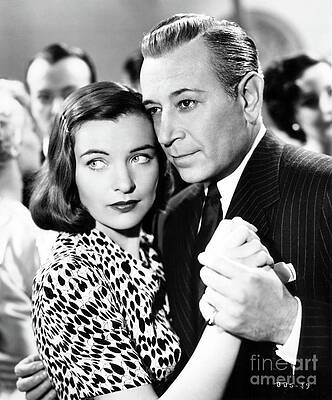
  • George Raft. Why?

    TCM, the indispensable channel, has been delivering us a raft of old George Raft movies. They Drive by Night (1940) of course, but also such unmemorable noirs as Johnny Angel (1945), Race Street (1948), and I'll Get You (1952) as well as a couple of others so unsubstantial that, although viewed during the past month, they've already evaporated from my tired old brain.

    This last while, whenever a George Raft picture began, we'd set a challenge: will Mr. Raft's face show an expression? Any expression! Will he smile, smirk, pout? Will he be angry, contemptuous, happy, lustful, disappointed? Anything at all, any human emotion? After painstaking study, I can now report that although we've examined every single frame, slowly and carefully, not once in any of these films has George Raft exhibited the slightest discernible human feeling. Moreover, on even more diligent examination, I can now affirm that he has delivered every single one of his memorized lines without the least variation in speed, volume, pitch, or intensity. Every sentence, no matter its significance, exits his mouth with the exact same cadence. It's all low affect, all the time. 

    It's a puzzlement. What was George Raft's appeal? Certainly not his skill as a thespian. Nor his negative charisma. He's not handsome, and because of his oddly short legs, he walks funny (and he walks at exactly the same speed when crossing the nightclub floor to question a "canary" or when prowling a dark alley, gat in hand. 

    Even more astonishing — in a couple of these movies he's cast as a romantic lead who gets the girl in the last scene — a girl who is younger, prettier, taller, and a much better actor. There's nothing more embarrassing or impossible-to-take-seriously than a George Raft kiss and fade. The End.

    George Raft with Ella Raines.  

    George Raft Photograph - A Dangerous Profession 1949 by Sad Hill - Bizarre Los Angeles Archive

  • The “Yips”

    The yips have been big news this week because Jose Altuve, Houston's golden-glove second baseman has made three throwing errors in two games. Glaring, costly errors. He's bounced balls to first base and to second base — throws of twenty or forty feet which he has made successfully thousands of times in his outstanding career.

    The "yips" is sports jargon for the sudden, inexplicable inability to make an ordinary or routine play. It's commonly used by golfers when they start missing short putts –but baseball has its famous yippers — Steve Saxe, Chuck Knoblauch (both of them second baseman who have the shortest, easiest throws)  and now, possibly Altuve. Sometimes a good pitcher will lose his control and start to miss badly; the retired pitcher at the microphone will say, "he's lost his release point," which is a yippish diagnosis without using the word. Athletes think that the problem is psychological but it's possible that the condition is merely neurological – a "focal dystonia" or muscle spasm in the wrist. Basketball yips? Yes, sometimes a good foul shooter will miss four or five in a row. 

    I suspect that the yips may not be a sports-only syndrome.

    Once, a decade or two ago, I was driving across the country on a four-lane and needed to brake. For some reason, my feet (I was driving a standard transmission so both feet and the clutch pedal were involved) couldn't remember which was the brake pedal. I flailed with both feet and was utterly panicked for about five long seconds. Then I came to my senses, put the correct foot on the correct pedal, and continued on in normal fashion. Life continued. But if I had crashed the car and killed myself, which was certainly a possibility, investigators would have thought that I had fallen asleep at the switch. They'd have been wrong; it was just the yips — a failure to perform a task that should have been entirely routine.

    I wonder how many road disasters are caused by undiagnosed yippishness.

    Do actors get the yips? Do musicians? Dentists?  Airline pilots? Surgeons ("You know, I've done that back surgery hundreds of times but three out of the last four, I've sliced entirely through the guy's spinal cord").

  • There is no author with whom I feel greater kinship than with Michel de Montaigne and there's none with whom I've passed more hours and days, except for Shakespeare. For many years, Montaigne's Essais has been my bedside companion, first in the old Everyman Library edition as translated by John Florio, a book which I early discovered among my father's small collection, and latterly in the 1958 version by Donald Frame. Of the two writers, Shakespeare is the greater, but he is unknowable and certainly not a comrade. "Negative capability" — and all that. Shakespeare, the human being, lies hidden behind a profusion of characters and borrowed stories. Sometimes I think I can catch a glimpse of the man himself in recurring images or in a repeated motif, but how can I be sure? It's all guesswork and supposition. Shakespeare is an auctor absconditus. He can be admired, even revered, but he's too mysterious ever to be a pal. Montaigne, on the other hand, is insistently present. He talks directly to me, guy to guy, teaches me, argues with me. Even though there's a universe of differences between me and this astonishingly erudite sixteenth-century French Catholic skeptic, I feel that we are good friends.

    Why the kinship? Montaigne is so various, so mutable, so inconsistent, that he's difficult to define, but nevertheless exhibits traits with which I l am in deep sympathy. Of all the important thinkers, he's the least systematic — which is a benefit, at least for me. I can't make heads or tails of his near-contemporaries Spinoza or Descartes because both are too orderly and logical for my unsubtle head. But Montaigne works differently — he advances an idea, modifies it, retracts it, illustrates it with a dozen anecdotes, and then announces that he can't come to a definitive conclusion — which is the way my mind works, although obviously at a much lower order. And then Montaigne's brain is a hodgepodge, a gallimaufry of formidable learning strewn in heaps, like the last scene of Citizen Kane. So is mine, although it's a cramped attic compared to Montaigne's warehouse. And of course, Montaigne writes almost exclusively about himself, as I do in these fragmentary blague entries.

    Moreover, we both seem to be at least in part writing for the same purpose. I compose these essaylets for what I conceive of, pretentiously, as dynastic reasons. Because I I so much wish that I had some artifacts or writing of my grandparents or great-grandparents, who left nothing behind, no scrap remaining, I want my descendants to have something of mine. Montaigne agrees: "What a satisfaction it would be to me to hear someone tell me of the habits, the face, the expression, the favorite remarks, and the fortunes of my ancestors. How attentive I would be. Truly it would spring from a bad nature to be scornful of even the portraits of our friends and predecessors, the form of their clothes and their armor." [Montaigne came from a family with a strong military tradition, unlike mine, which is epitomized by grandfather's desertion from the Russian army.] "I keep their handwriting, their seal, the breviary and a peculiar sword that they used, and I have not banished from my study some long sticks that my father ordinarily carried in his hand." I have no "sticks," but as I sit here pecking at the word processor, I see out of the corner of my eye my father's library ladder, used for retrieving just the right law book.

    Montaigne is not done with the topic. He continues by exploring an idea about which I also have ruminated. For whom do I devote these hours, if not for myself?  He is eloquent upon the subject.

    "If no one reads me, have I wasted my time, entertaining myself for so many idle hours with such useful and agreeable thoughts. In modeling this figure upon myself, I have had to fashion and compose myself so often to bring myself out, that the model itself has to some extent grown firm and taken shape. Painting myself for others, I have painted my inward self with colors clearer than my original ones. I have no more made my book that my book has made me — a book consubstantial with its author, concerned with my own self, an integral part of my life….  Have I wasted my time by taking stock of myself so continually, so carefully. For those who go over themselves only in their minds and occasionally in speech do not penetrate to essentials in their examination as does a man who makes that his study, his work, and his trade, who binds himself to keep an enduring account, with all his faults, with all his strengths."

    I wish I could say that I'm as honest as Montaigne; I'm not. I recognize that the "me" that appears here is to some degree different from the me that is me. Although I do not lie about myself, I conceal some of my most flagrant deficiencies. Nor do I blow my own small trumpet. As a result, the portrait that has emerged is solider and also less troubled than the true-to-life person. Don't say I didn't give you notice, unwary descendants. 

  • It's unlikely that I will be killed by a tsunami. I just don't get to the seashore very often — the last time was five years ago — and I happen to reside most of the year at an altitude of 5300 feet. It would have to be one heck of a tsunami that would find me here — 1200 miles inland. An ordinary rainfall-caused flood is a more likely cause of death. We have a big one every decade or so. But still, I live on the second floor of a concrete and steel-I beam building and even a thousand-year event wouldn't touch me. I might be in danger if I happened to be hiking in one of our many narrow canyons, where you see signs that say "in case of sudden flood, climb to safety." But I'm not much worried about a narrow canyon situation because I like to stay home and in bed when it starts to rain or even when there's a threat of rain. For the same reason, I'm not afeard of dying in an avalanche. I don't ski and I don't climb mountains, especially in the winter. In fact, I tend to stay at home, sipping hot cider, on cold days because I'm afraid of slipping on the ice and busting an arm or a leg or a hip. A volcano, then? Not likely. There are no active volcanoes nearby and those hotspots under the geysers in Yellowstone aren't scheduled to explode for a few hundred thousand years. I just can't see myself racing ahead of a pyroclastic flow. A forest fire? Always a danger because they've become more frequent with global warming. Nevertheless, I don't think a forest fire is likely to kill me because even though I live less than a mile from the mountains, there's enough buffer between my home and the forest that it's pretty impossible for a fire to cross into my zone. (A house fire is even more unlikely, especially because of the up-to-date built-in sprinkler system and the cinderblock-enclosed staircase). I suppose I could be killed by a lightning strike but I'm not likely to be outside dancing during a sudden storm. A hurricane — well, we don't have any here and although I spend a significant amount of time in New Orleans, I limit my visits to the late winter or early spring, so I'm not in residence during  the bad season. A tornado is a remote possibility. Once again, I'd have to go far to find one, because they don't seem to come into my city. I once identified a funnel cloud out to the east, but it didn't touch ground. A blizzard? Well, I've certainly experienced blizzards and once I was caught in one, but frankly, unless I should happen to drive the Subaru into snowbank and freeze to death, or go out for a long walk in the open space in the midst of a storm, I'm not likely to perish. Then there are earthquakes, which would be a real possibility if I lived in California or along a fault, but not here in the stable Rockies. So on the whole, I don't think I'm going to die in some natural disaster. 

    Wait, what about a meteorite falling from the sky and bopping me on the head?

    Actually, that sounds like a good way to go. No long period of fear and anxiety waiting to drown or burn or be buried, just instant death while strolling in the park on a sunny afternoon. A perfect ending.

    Which reminds me of the death of Aeschylus, who, according to the story, while walking on a beach, was killed when an eagle picked up a turtle, and trying to break its shell, dropped it on him, thinking that his bald head was a large rock.

    Death by falling turtle — ridiculous. Death by meteorite — glamorous and romantic. A story for latter generations to savor.

    Oh, oh. I just thought of another natural disaster. Sinkholes. I don't want to be swallowed by a sinkhole. Not at all glamorous. Memorable, yes. Glamorous, no.   

  • Dear Diary: why is everybody always picking on me? It's been a really bad month, even before someone deliberately gave me the virus. Sometimes I want to cry, it's been so tough, but Daddy Fred would hate me for that. The press, the TV people, some of those losers at Fox (not Hannity). Even my own niece, Mary, who claims that I cheated her out of millions of dollars. What an ugly bitch she is!  And then someone leaked that I called American soldiers losers and suckers for dying — I never said that, and if I did, it was private. They claimed that I wouldn't visit that frog cemetery because it would mess up my hair — well, I paid $70,000 for my hair and they want me to go to some foreign cemetery for some war that nobody's ever heard of — in the rain. Fuck, not me. That's for dummies. Then I went to Tulsa for a celebration of me me me and nobody showed up. Parscale was responsible for that mess;  I got rid of him. Someone will try to get him to rat on me, but he won't. I've got him by the pecker because of all the money he's embezzled. And then some disloyal son of a bitch leaked that I said that the virus was good because I could get away without shaking hands with donors, Of course I don't want to touch them, they're disgusting losers, full of germs. But I got to take their money, I don't want to spend mine. I'm already into Putin for millions. My pussy advisors tell me I have to pretend to be friendly, when I'd rather relax at Mar-a-Lago and eat cheeseburgers and spend time with Hope. Then, a couple of days ago the nasty, failing New York Times has a big story about my income taxes. Fake. Fake. Fake. I pay plenty, of course a lot less than loser teachers and nurses who don't know how the system works. Then Woodward, who I thought would give me good press, says that they're all ganging up on me behind my back. Cowards and losers. Woodward says that wacko Mattis, the turncoat, said that I had the understanding of a fifth or sixth grader. How can that be — my uncle taught at MIT? Plus I had great SAT scores. Dummy Kelly thinks I'm an idiot and unhinged. That blimp Omigault says that I'm a racist, a misogynist, and a bigot. Wacky nut job Gary Cohn says I'm as dumb as shit and corrupt McMaster called me a dope. Publicity-seeker Bannon says that I'm like an 11-year old child. Lightweight grandstander Tillerson called me a moron. What's with all the name-calling? Good thing Jeffrey Epstein pulled his own plug, if he really did, he had me worried for a while. Then all these dumb women! All out to get me!  Katie Johnson and Summer Zervos and Jean Carroll and twenty others. They all wanted it bad and then they changed the rules and now they're out to cash in. Sad! Low IQ slut Stormy still trying to make me look bad. And Rudy lobbying me every day to pardon Manafort and Roger Stone and his other friends. Sometimes I just want to go to Russia and move in with Putin. God I love that guy. I wish Roy Cohn was still alive. So much smarter than disgraced idiot Michael.

    Why is everybody always picking on me? 

RECENT POSTS


ARCHIVE