Dr. Metablog

Dr. Metablog is the nom de blague of Vivian de St. Vrain, the pen name of a resident of the mountain west who writes about language, books, politics, or whatever else comes to mind. Under the name Otto Onions (Oh NIGH uns), Vivian de St. Vrain is the author of “The Big Book of False Etymologies” (Oxford, 1978) and, writing as Amber Feldhammer, is editor of the classic anthology of confessional poetry, “My Underwear” (Virago, 1997).

DR. METABLOG’S
GREATEST HITS


  • IMG_0514

    This standing stone might look like an ordinary piece of granite, but it has a rich history. If you look very closely, you can almost see the two deep holes that have been drilled into it. Though it's now merely a garden ornament, decorating a perennial border, it was once a working fence post. Hinges would have been hammered into the holes.

    We found this post up on the hill, deep in the second-growth forest, very close to the remains of what was either a well or a cesspool and beneath the giant senescent maple that must date from pre-Colonial times.

    There's also a second megalith, also drilled but not visible in this picture, that now guards a parallel perennial border. Long ago, the two posts flanked an old farm road but the wooden gate that once stood between them had already rotted and disappeared fifty years ago when I first happened upon the posts.

    The area where the post stood is surrounded by numerous substantial stone walls that once delineated the boundaries of various fields. Tom Roberts, who farmed the property from 1926 to 1967, told me that he grew apples and potatoes on the hill. There's no need for a gate for potatoes, so the posts must date from a previous era when the land was used to pasture sheep.

    We decided to honor the posts by placing them in a more prominent position, so one day we loaded them into the bucket of the Deere tractor and brought them down. We dug a hole about a third the length of the post, chained it to the bucket, and lowered it into place. NGP is getting to be mighty skillful at maneuvering the tractor. The posts are handsome in their new situations. Robins like them too, as places to perch.

  • I just completed another long stroll through Bleak House. It's either my fifth or sixth time through — or almost once a decade since 1958. During this reading, which will no doubt be my last, I felt that I was imprisoned by the novel, hogtied; that I couldn't do anything or read anything else until I made it to the end of entire 900 pages. Dickens took over my life, and not for the first time. It was a struggle, perhaps made worse because my eyes are not as good as they once were and because the print in my Oxford Classics edition seems to be growing tinier and grayer.

    It was a willing surrender and I was a willing captive. How can I not be dazzled and impressed by the profusion of Dickens' imagination and by his genius at keeping a dozen plot-balls in the air. 

    Nevertheless, I don't ever remember being quite so angry and impatient at Mr. Dickens.  "Let 'em wait." Well, I waited for five days, which as fast as i can trot nowadays. 

    The good parts of Bleak House are as good as anything in the language. The death of Jo the crossing sweeper ("And dying thus around us every day") remains the single greatest paragraph in the long history of the English novel. "Dead, your Majesty." The encounter of Sir Leicester and Rouncewell was much better than I remembered it. Mr. Chadband, the oleaginous preacher, was, this time, remarkably pertinent. Mr. Bucket is a triumph. Lady Dedlock's long repressed love for Captain Hawley was more poignant.

    But I've lost my admiration for some other parts of the novel. I could hardly bear Esther Summerson's goody-goodiness; and, this time, I have to say that Esther's relationship with her dear darling Ada seemed suspect. Far too sentimentalized. Ada herself, still in mourning seven years after the death of her misguided weak husband — unbearable.  The Jellyby and Pardiggle satires seemed misguided, excessive.  I was not amused by Mrs. Snagsby's jealousy or by the relentless pillorying of poor Mr. Guppy. Harold Skimpole's infantile nattering has lost its charm.

    There's never been a novelist with more heart or less intellect than Dickens. He is the best of novelists, the worst of novelists. 

  • Curious New Words

    In his new book on the Vikings, Neil Price uses some words that I didn't know. Some old, some new.

    "Haptic" — relating to the sense of touch. A "byre" is farmhouse in which humans live in contact with livestock. A "volute" is a spiral or scroll-like ornament. An "allodium" is land held absolutely and not subject to feudal duties or burdens. A "skald" is a Norse poet. "Theophoric" refers to words, often place names, that embed the name of a god or goddess. "Futhark" is an early or older form of the runic alphabet. A "quern" is a simple mill for grinding grain and consists of two stones, one on top of the other. A "dirham" is an Ottoman coin; the word derives from the Greek drachma. "Tephra" is fragmental material produced by volcanic eruption. A "sigil" is a symbol used in ritual magic. "Lamellar" is the adjectival form of "lamella," which is a thin flat overlapping scale, in this case used to describe a kind of leather armor. A "hydrarchy" refers to the rule of a piece of land from shipboard, and also to "a pseudogovernmental system of law between pirates at sea." "Emic," a fire-new word, describes the analysis of a culture from the perspective of a member of that culture. And my favorite (how could I not have encountered this word before?) — an "ogonek" is a diacritical hook placed under the lower right corner of a vowel. 

  • vikings

    I read all 599 pages of Neil Price's just-published Children of Ash and Elm, a detailed history of the Vikings, and I'm mighty proud of myself for persevering.  It's a long book bristling with details and data. The author, an archeologist, has made his own original contributions to Viking research. To produce this synthesis, he seems to have read every relevant article and monograph of generations of scholars. An impressive feat. I wonder, how much will my intermittently faulty memory retain? 

    Has my understanding of the Vikings changed? Yes, I think it has. I knew that the Vikings were famous for cruelty, plunder, pillage and rape, but I had no idea that they were so deeply involved with human sacrifice and slavery.  "The Vikings," says Price, "were not only slavers, but the kidnapping, sale, and forced exploitation of human beings was always a central pillar of their culture." Slaving was "the main element" of commerce with Russian and Ukraine. The chapter on Viking slavery is grim reading indeed. It won't make you proud of your species. 

    Here are a couple of Viking slave collars

    Image result for viking age slave collar

     
    Image result for viking age slave collar

     
    Vikings were polygynous and when a minority of the males monopolize the women, the rest have to find companionship and satisfaction elsewhere. Vikings liked to locate a settlement, kill the men, and capture the women. Recent genetic studies have determined that the founding population if Iceland consisted in large part of Viking men and Scottish women. 
     
    It's hard to believe that the age of the Vikings is only a thousand or so years into the past — a blip in human history. To me, the hideous cruelty of their era figures the dark heart of European and probably all human history. Do not slave labor, pogroms, and genocide periodically erupt?  And yet the Scandinavian cultures that descend from the Vikings are now the most democratic, progressive, and egalitarian on earth. Perhaps there is hope.
     
    Those are Viking teeth in the picture above. Price thinks that the filed grooves were filled with some sort of red dye, making the Viking smile truly terrifying.
  • My Dreamatorium

    The house was surrounded by bears. They were, I must admit, not very convincing bears — my dreamatorium didn't seem to be able to generate realistic grizzlies. Instead, these bears looked like actors in bear costumes. Even though they were silent, they were menacing and I was frightened. I remained inside the house trying to protect some children who may or may not have been my own offspring. I thought, if I just fire my pistol into the air a few times, I should be able to scare the bears and drive them away. So I started to look around for my pistol, but no luck. I searched the drawers, several of them, and also looked through my luggage. No weapon. Then I had a revelation. I remembered that it's not in this dream that I have a pistol — that was in an earlier dream, a few days or a few weeks ago. If there's no pistol, how do I deal with the bears?  I was out of ideas, but just then a woman, not someone known to me,  but middle-aged and blonde, appeared, and inquired, do you want me to get rid of the bears? What is your plan, I asked, and she responded, with the "performance." A "performance"? She added that it would cost me a bit of money but that we would settle about the payment later. I agreed with the plan and told her to go ahead with the performance. Which she did — she gathered a number of people, including some very young children, who formed themselves into a circle and sang a song (more like a chant) and danced. The performance chased the bears away, so I woke up. I never did settle with her about the fee.  

    It wasn't my best dream — but it's not entirely without interest. I'd give it a B-plus at most. I admire the details about the wrong-dream pistol and about the "performance."  By the way, I've never owned a pistol and haven't had a weapon in my hands since ROTC in college, and I have no idea why my dreamatorium is so convinced that I did so.

    I continue to be amazed that my nighttime life is so much more inventive than my daytime. In actuality, I'm not at all an imaginative person. When I set out to write fiction or poetry, which I have done at various times in my life, it's a disaster. The truth is that I have nothing to say. No plots, no situations, no dialogue, no wit, no insights. And yet, night after night, I find myself in crazy, bizarre but also imaginative situations. I wake myself out of dreams, like this one, that refer back to past dreams — as if Tuesday's dream, were a continuation of Monday's and Monday's a piece of a continuing narrative — as if my dreams were chapters of a long novel or perhaps episodes in a TV serial.

    My dreams are almost always nightmares. I'm lost in a strange city, can't find my way back home. Surrounded, defenseless and alone, among enemies. Infinite variations on themes of helplessness and hopelessness.

    The pleasant dreams are very few but they can be inventive and fun. Once I dreamed that I could swim like a fish, not by flailing my arms but rather by swiveling my entire body. I was as as quick as a pickerel. And several times, I had gravity-defying dreams in which I compete in the long jump, but don't come down, just skim along the surface of the earth like a Greek goddess. A very liberating fantasy. 

    It wouldn't be difficult to interpret the bear-pistol-performance dream. Life is dangerous (the bears), there are possible remedies (the pistol), but community support (the performance) is more effective than individual action. If I were feeling Jungian, I could find all sorts of bear or half-bear archetypes in the folklore. I'm absolutely positive that sometime during the long haul from the Olduvai Gorge to Ellis Island, one or more of my ancestors, living in a cave or a daub-and-wattle hovel, faced off against carnivorous creatures. Perhaps the dream emerges from some atavistic portion of my brain or is embedded in my DNA.

    But I don't believe it. I attach little meaning to dreams. Surely, they reflect one's anxieties, but they don't predict the future or explain the deeper mysteries of life. I think that they're nothing more than the chemical circuits of the brain going haywire. It takes a lot of effort to keep the synapses under control, and when we sleep, those controls are compromised. We become unhinged. Didn't WS say something like lunatics and dreamers are of imagination all compact?  Or did he?  Well, lunacy and dream and imagination are closely related, whether he said it or not.

  • tSecretFury.jpg

    There are amnesia movies and there are gaslighting movies. The Secret Fury is both, and, I'm sorry to say, it fails to hit two separate marks.

    A bad bad lawyer and cadre of hired subordinates contrive to gaslight rich Ellen Ewing (Claudette Colbert) into believing that, while amnesiac, she killed a man. In any recognizable universe it would be impossible or at least extremely difficult to persuade a sensible, mature woman that she suffers from a loss of memory. Not in NoirThrillerMysteryLand, where amnesia is just about as ordinary as a case of summer sniffles. So Ellen takes the amnesia bait and gets herself consigned to a mental hospital until her boyfriend David McLean (Robert Ryan), who is not the swiftest, finally figures out what's going on, and after a frantic fistfight, rescues and vindicates his lady.

    I myself was thoroughly confused by the multitude of loose ends in the plot. Who was it who strangled the hotel maid, played by Ethel Mertz aka Vivian Vance? And why? 

    Bosley Crowther of The New York Times, who hardly liked anything at all, was more-than-usually outraged by this film. He called it "wantonly unintelligible" and "cheap and lurid trash." I rarely agree with BC, but in this case he he went easy on The Secret Fury. I was equally infuriated — The Secret Fury is a film without a shred of integrity. But what's to be expected when a phony case of false induced amnesia is at the heart of the matter? 

    I feel for Philip Ober, who put his heart into playing the villain and was forced to mouth with a straight face some of the most ludicrous dialogue ever composed. I feel also for Jane Cowl, a graduate of Erasmus Hall High School, who played bland Aunt Clara. Jane Cowl had a long career and appeared in many respectable films. This one is an embarrassment.

    So is the crowded, unartistic poster.

  • IMG_0500
    These very pretty pieces of china mean nothing to the world at large but they have great importance to me.

    When I was a boy, the only holiday that was celebrated at 539 East 9 Street was Thanksgiving. Why was it not forbidden along with all the others? The reason, I suspect, is that it was the holiday least tainted by religion.

    My parents were not sociable people and Thanksgiving was the only time of year that our house ever saw a guest or that I experienced conviviality — which is why this particular china pattern of became important to me. My parents owned a broken set — perhaps a dozen or so pieces. I don't know how or when they were acquired, or why, but I do know that they appeared, annually, in November. To me they said, and still say, not only turkey and sweet potatoes, but friendship and laughter.

    I'm still surprised that they owned such handsome pieces — far too fancy and decorated for our modest utilitarian household.

    I inherited these remnants because neither of my brothers expressed any interest in them. For the record, they are Charles Field Haviland, commissioned by Macy's, and originally manufactured in 1938, so they would have been newish when acquired by my parents. I once knew the name of the particular pattern, but I've forgotten it. In the catalogue they're listed as "Head 174".They are terribly respectable and have "establishment" written on their faces, but they have almost no monetary value. Less than nothing, in fact — you'd have to hire a couple of guys to cart them away.

    One day, on ebay, I found on auction a full set of of what I had come to think of as "my family pattern."  A hundred or so pieces — three different size plates, soup bowls, cups and saucers, serving dishes, sugar and creamer, a butter dish — the works. Needless to say, it was not difficult to outbid the competition. I "won" the auction — a small triumph which I choose to regard as tribute to my heritage.

    Now, whenever we have guests, which is a lot more frequently, believe me, than it was in my family of origin, out come the Charles Field Haviland dishes. Especially at ceremonies and Thanksgivings.

    I'm sad that my children show not the least interest in this chinaware. But why should they? They were not a mysterious feature of their childhoods.

    Perhaps, some day, one of the seven grandchildren will be intrigued. But I'm doubtful. 

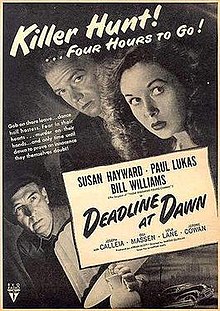
  • Some very serious contributors to film art created this almost forgotten whodunit. Deadline at Dawn was adapted from a novel by Cornell Woolrich and the screenplay was written by Clifford Odets. Cinematography was by Nicholas Musuraca and direction by Harold Clurman. That's some pretty good bloodlines. Moreover, the principal roles were played by young, sparkling Susan Hayward and by the always reliable Paul Lukas.

    Deadline at Dawn movie poster.JPG
     
    I found it a fascinating film and, strange to say, quite original. Original?? When almost all the plot elements come directly from the vault of overused noir tropes and cliches? Yes, a murder is perpetrated in the first scene. And guess what? We the spectators are kept in the dark and only see the killer's back and hands. And, oh no, an innocent man is accused of the murder and has only a few hours to prove that he didn't do it. But as luck would have it he falls in with a worldly-wise young lady who undertakes to help him and with whom, you can bet the house, he's soon going to fall in love. There's also a "bad girl" who does a little in the blackmail line. And a tough, excitable gangster who several times pulls a revolver out of the breast pocket of his vividly checked suit jacket. There are not one but two car chases. And a shrink-wrapped pair of deep-dyed red herrings. A pair of not-so-bright police detectives. Believe it or not, the film digs so deep into the treasury of cliches that it brings up a brief episode of — gasp– amnesia.
     
    Nevertheless, these predictable elements are deployed in genuinely surprising ways. I confess that I was taken by surprise by twists and turns in the plotting and I never had the least clue that the wise old cabbie would play so important a part in resolving the mystery.
     
    Deadline at Dawn defies the genre — a bit. In 1940s murder mysteries, it's taken for granted that American society is massively corrupt and venal to the core. Everyone is on his own and everyone is on the take. But it's not so in this film. The young sailor who is accused of murder is a decent, upstanding patriotic young man. The woman who comes to his aid pretends to cynicism but turns out to be as innately noble as he. The various minor characters whom Alex and June encounter during their hunt for the real killer are uniformly kind. There's a newsstand owner who returns to Alex the wad of cash that falls out of his pocket; a fruit seller who joyfully packs for Alex a bag of bananas; the nervous guy who acts suspiciously but is only worried about his dying cat; the apparent stalker who turns out to be a harmless eccentric; the "super" and his wife sitting on the stoop who appear to be hostile but help June find her way; the policemen who come to the aid of the drunken baseball player; the blind pianist who turns out to be not villainous but just unhappy; and especially, the philosophical taxi-driver who sacrifices himself to help Alex. The blackmail and the murders are overlaid on a culture of decency, so that the upbeat conclusion seems to be organic and natural rather than a mechanically-attached Hollywood ending.
     
    I suspect that the supporting cast of thoughtful kind working-class stiffs is the contribution not of Woolrich but of Odets.
     
    Who would have thought it?  A noir whodunnit with a heart of gold.
  • IMG_20200824_192811

    It's a lawn mower, or as the John Deere people like to call it, a lawn tractor. We call it a "riding mower." I've spent a thousand hours upon it and upon its used-to-death predecessor. Keeping up the lawns take just about three hours — twice a week in May and June, bi-weekly come a dry September. It's a useful machine — uncomplicated, rarely out of service, finely engineered. With its wide cutting deck, I can maintain the lawns with minimum of fuss. It's a royal pain when it does break dow. You can read such a failure here. 

    But it's not the mower but the #10 cart that has changed my life for the better. I came into possession of the cart twenty years ago, and have used it, hard, every summer since. Sometimes it develops a flat tire, but otherwise, it's perfect.  

    In the pre-cart days, from 1968 to 2000, I possessed only a battered old wheelbarrow. If you want to move manure from the pile to the garden, you can fill a wheelbarrow with about two cubic feet of material. Then you use your own personal arms and legs to haul the wheelbarrow to its target, always uphill, and dump it. But if you  use the cart to move manure, you can fill it with a full cubic yard or perhaps more of the "well-dried." Then you hop gracefully onto the lawn tractor and let the mower pull the cart to your garden. The machine does the hard work and your back doesn't "go out." (The rear panel of the cart is  removable and with not much effort the front of the cart can be raised to dump stuff out the back). You drive away a few feet and the cart empties itself.

    Same thing with brush. If you've accumulated a couple of hours worth of brush and weeds, and you want to move it to the brush pile — why then, a trip's worth is only what you can carry in your arms. But with the cart, you can stack and compress the stuff and move ten times as much, especially if you've learned how to make use of bungee cords. And again, you don't have to carry or drag; you let the machine do the hard work. Some decry the gasoline engine, but I'm all gratitude.

    The cart allows me to do many times the amount of work as a wheelbarrow, and at much less cost to my aging body. It's a gol durn miracle. 

    (Those are NGP's miniature donkeys, Big Joe and Little Joe, in the background. They may not be aware of it, but they've also made important contributions to garden fertility.  

  • We settled on University Hill by lucky accident. Shortly after accepting a teaching position, I received a letter from my then-chairman Harold Kelling, urging me to write immediately to Professor J. D. A. Ogilvy, who had a house to rent near the University. I jumped to follow instructions and in August, 1969, the four of us (ages 30, 29, 4 and 2) took up residence in a small and lovely jewel of a Craftsman bungalow at 9th and College. It was not only a splendid home in which to start life in Boulder but it was also conveniently located: walking distance to Norlin Library, to the bus to Denver and to the Boulder Public Library, as well as just a block and a half from Highland Elementary School. We lived in that fine house contentedly until January of 1973, when (we were now 5, Eve having joined us in June of 1970) it became clear that we needed room to grow. The boys, Nathaniel and Ben, were adamant that we must remain in the Flatirons school district (Highland had been closed and abandoned — a significant loss to the community). The children had good instincts; Flatirons Elementary was a wonderful school. It was led by Robert Rea, the finest principal I've ever known. During the winter of '73, we migrated from 9th all the way to a 10th street house that had, as they say, "good bones" but which had been "modernized" — actually brutalized — by a succession of owners who had trashed almost all of its Arts and Crafts splendors in favor of oversized mirrors, bright green shag rugs, beaded curtains, flocked wallpaper, and plate glass (replacing stained glass) windows. But heck, it was spacious for a family of five even though fabulously expensive ($46,500). We felt fortunate. There was a bonus: when Althea returned to work after a seven-year interval of pregnancy, birthing, and nursing, she was able to walk back and forth to Boulder High School, where she taught mathematics for many years. With the purchase of the house, our commitment to the Hill strengthened.

    10th street was our home for 35 years. Over the course of the decades, we restored our abused home to the extent that our resources permitted. We added insulation (its first) and a modern kitchen, refinished the oak floors and stripped the paint from the warm fir woodwork, replaced the wallpaper and allowed the ornate brass registers to glow once again — and moreover, transformed a backyard wasteland into a pleasing peony-iris-daylily garden. I'm proud to say that we left the house in much better shape than we found it. Meanwhile the neighborhood, sad to say, did not improve along with us but spiraled downward. In 1973, when we arrived, three quarters of the 24 houses on our street were owner-occupied; when we departed in 2009, only four or five houses remained in family hands and the rest had devolved into rentals — occupied and often over-occupied by CU students. Our block was representative of developments that took place on the Hill during our years of residence. While the Hill had once been an essentially peaceful place, with only a rare disturbance, by the turn of the century, it had deteriorated into a combat zone where we and our adult neighbors engaged in constant struggle with graffiti, overflowing trash bins, weedy untended lawns, noisy late night and early morning sleep-obliterating parties, neglected barking dogs, gratuitous intermittent fireworks (explosions, actually!), thefts, vandalism, as well as fraught face-to-face encounters with rude entitled young malefactors.

    What had happened between 1969 and 2009? What caused the decline from a thriving pacific neighborhood to a disorderly student ghetto? There were a host of factors, a few of which I can enumerate. Probably most important is that the University added at least 10,000 students during those years and did not provide housing for a single soul. The Hill, just across Broadway, was easy pickings for enterprising landlords, many of them decent but some unscrupulous, who bought advantageously, and (inasmuch as rental licensing codes were largely ignored and unenforced), maximized their income by dividing dignified, solid old Victorian or Arts and Crafts homes into rabbit-warrens. Many of the new occupants were first-time-from-home students who came from far away, spent a semester or two boozed up and hung over, failed out, and left behind their tuition money, their damage, and their trash. What might have been profitable for CU was disastrous for the neighborhood. Along with the increase in the absolute number of students came a resurgence of fraternities. During the late 60s and early 70s, when many students opposed the Vietnam war and conceived themselves to be anti-establishment, fraternities were among the institutions that were disfavored. Membership in the frat clubs declined significantly, but then recovered with the coming of the more conservative, less troubled Reagan era. I need not dwell on the fact that the burgeoning fraternities, flaunting an ethic that was anti-intellectual and pro-alcohol, were a major cause of increased neighborhood disruption. Along with these factors, came the replacement of marijuana, the drug of choice during the antiwar era, with beer. Marijuana, at least in the mild varieties of the 70s, is a contemplative drug while beer is a noisy one.The turn to alcohol had the effect of increasing the number of bars at 13th and College; while there had only been a couple of drinking establishments when I arrived (Boulder had been "dry" until 1967), by the time I left, there were more than twenty such, and the area had become a drinking "destination" that attracted outsiders to the street and inevitably also to Hill fraternity and house parties. And then sometime during the 70s or perhaps early 80s, the University moved many classes from a Monday-Wednesday-Friday to a Monday-Wednesday schedule, which meant that the weekend, and weekend drinking, now began on Thursday night and continued until Monday morning. It was sometime during this period that a couple of national magazines proclaimed CU as the nation's Number One Party School, which I must assume negatively impacted its pool of applicants. In addition, the welcome liberation of women from oppressive social restrictions had an unintended consequence: it led to much more alcohol consumption by female students. What had once been a rarity — a drunken woman — became, I'm sorry to say, commonplace. (I had become accustomed to male revelers untrussing and pissing on my roses, but I was genuinely flabbergasted to see young women pull down their panties to squat on my front lawn). Still another factor was the advent of the cell phone, which made it easy for small nomadic bands of young people to find each other and rapidly coalesce into sprawling alcoholic hullabaloos. Both the city government and the university, two institutions that should have noticed these developments, remained supine and indifferent.

    Then came the riots. In 1971 there had been a protest, which turned violent, against Nixon's secret bombing of Cambodia. But the scary riots of the 80s lacked a political or social agenda — as far I or anyone else could tell, they were meaningless expressions of anomie, anarchy, and vandalism. Asked for justification, students claimed that "there's nothing to do in Boulder but drink" — an unpersuasive argument about one of the most prosperous small cities in the nation, one in which gymnasiums, theaters, libraries, hiking and climbing trails, swimming pools, and other recreational opportunities abound. The Hill experienced four riots in three years — associated, if I remember correctly, with Hallowe'en or homecoming. Sloppy, reeling revelers crammed the streets, overturned vehicles, and hauled couches off porches to set dangerous street-corner fires. I remember one instance in which rioters on the prowl for fuel appropriated a substantial section of the wooden fence at the alley side of my lot. At last, the city took notice. A commission was empaneled to study and make recommendations. I attended a few of these meetings and was impressed by the seriousness with which the panel took its responsibilities. Members from the Hill neighborhood were Terry Rodrigue and Annie Fox. A report was issue and recommendations were made, but to no perceptible effect, and the deterioration continued. 

    The riots led to the re-founding of the University Hill Neighborhood Association by the late Jane Stoyva, Rosemary Crowley, Steven Walsh, Lisa Spaulding, and  Eleanor DePuy, among many others. With my children now departed for college, I was able to become a contributing participant. Simply put, the Association was divided into two camps, which I thought of as the "enforcers" and the "socializers." The enforcers (among them Terry Rodgers, Gregg deBoever, and Ken Wilson) patrolled the neighborhood on Friday and Saturday nights, calling in violations to the police. The "socializers" (myself and many others) tried every which way to integrate the students into the community. In retrospect, neither the one nor the other technique had much of an impact.

    Nevertheless, the effort to socialize the young folk had very beneficial social side-effects, at least for me. For example, I was a member of a small group (with Kathy Tucker, Terry Rodrigue, and LeRoy Leach) that established the annual Beach Park Party (does it still exist?). Not only did these neighbors, who had been until then no more than faces to me, become my friends, but I had the delightful experience, several years in succession, of dishing out free ice cream to both adults and children. It was my best job, ever. On 10th Street, Althea and I initiated an annual block party, where, for many successive Septembers, we explained to new arrivals over hamburgers and beans that they were welcome to the neighborhood but that they should respect the people with jobs and young children who also lived on the street. For three or four years I was part of a group that met monthly at The Academy, trying to figure out how to make use of that institution's resources to benefit the community. I made a lasting friend with one of the participants, Ron Roschke, then pastor of Grace Lutheran. I edited an upbeat, cheerful bi-monthly newsletter that was distributed throughout the hill to permanent and new residents alike. In addition, I represented aggrieved neighbors at restorative justice hearings, where young scamps were counseled by their practiced attorneys that to clear their records and escape punishment, all they needed to do was to grovel a bit and feign remorse. I attended and spoke at many City Council meetings. I made many friends by patrolling our street on Sunday mornings with a black plastic bag, picking up beer and soda cans, empty cigarette packs, those ubiquitous red beer cups, and various pieces of discarded clothing. (If there's a good reason why a bra should lie in the gutter on a weekend morning, I can't imagine what it might be.) I made my best Hill friend, Vin Scarelli, when we met at 2 AM, both of us on the hunt for "trumpet man" — a student who like to pop out of his house in the wee hours, blow his trumpet (it might have been a bugle) as loud as possible, and then scurry inside before anyone could nab him. The reward for these activities was that I became member of a vibrant community — and there's nothing like a common enemy to bring people together

    I left the Hill in 2009 in part because I was exhausted by the fight but also because Althea's illness had progressed to the point that we needed to live on one floor, with an elevator.

    I reside now in an age-appropriate downtown condo, but I regret that I can no longer walk around the block and enjoy a brief "how are you" with neighbors with whom I've collaborated on one project or another. I miss the society of the Hill, but not its disorder. Among its other virtues, there could have been no better place to raise children.

    One might succumb to nostalgia — except that when I sit on my Walnut Street balcony on a summer evening, I can hear distant booms coming from up there on the Hill, and I remember that they were exceedingly jarring and disturbing. The far off blasts remind me why I relocated and they cancel out any longing to return. But let me confess that if I were to come back to the Hill, I would return as a committed "enforcer."

    Can the Hill be saved, or is it doomed to further decline?  There's no better location — everything is at your doorstep — schools, libraries, Chautauqua, foothills, all the diverse riches of a large University. It's a neighborhood of great architectural integrity — an outdoor museum of 1900-1920 American design, almost as interesting as antebellum New Orleans or Art Nouveau Riga. Its housing stock is unparalleled in Boulder; in a better world, it would be a tourist destination. UHNA does a wonderful job of advocacy, but it's in an unequal contest with powerful political and business forces. I think it was during the 90s that a few of us, the late Neil King most prominently, tried to engage the university in an improve-the-Hill project. We proposed that the neighbors and the university (we hoped also for grant support) pitch in to create an entity that would buy houses on the Hill and rent them to, say, newly-arriving professors or staff who would otherwise be forced to commute from Lafayette — nowadays, Erie or Ft Lupton. And by doing so little by little to undo and reverse the tipping point and rebalance the ratio of adults to students. Although Neil was persuasive and influential (he had once been city attorney), he could not develop any traction with either the city or CU. I am not sure if our plan was workable, but I learned that to save the Hill will not be easy and will require big money, big thinking, and the coordination of many disparate groups. 

    In the meanwhile, the struggle between the  enforcers and the socializers continues. Should police educate or should they arrest and ticket our student hooligans?  Let's do both. If a new first year student arrives in Boulder on a Thursday, misbehaves during the weekend, and the following Monday forwards to his mommy and daddy the news of a $5000 fine — well, that will certainly be educational, will it not?

  •  
  • IMG_0475

    This is the most unusual and perhaps the most beautiful object I've ever owned. It's a rawhide or leather puppet used in traditional Siamese theatrical performances. On the reverse, it's dated 4 IX 85, or September 4, 1885,  which I presume is the day the puppet was acquired (or "collected"). I purchased it from an antique store in Denver in the early 1970s. The dealer explained that he bought from the estate of a local man who had been a foreign service officer in Thailand in the last part of the nineteenth century. I had never seen anything like it, didn't know anything about it, but fell for it in a big way, and have enjoyed it ever since.

    It's called a Nang Yai puppet, and I've written a bit about it here.

    She's a musician who plays a mandolin-like instrument. She wears an elaborately decorated outfit with long sleeves and pants. For many years, she hung in a north-facing window (our fierce Colorado sun would destroy her in a summer if she faced south). Now she has a light box all her own, and when she's lit, she dominates the room, but only in a benign way. She's harmoniously proportioned, graceful and not without a touch of majesty. To my eyes, she's radiant. She ennobles her surroundings. 

  • IMG_0486

    This woebegone object was once a plump and thriving stuffed animal — a bear, in fact, though for some reason my children always called him "Puppy." Their only other stuffed animal, a snake, was named "Snakey." Pedestrian nicknames to be sure. I admit that our family wasn't very imaginative about naming our mascots.

    Even though Puppy is past his prime, he's still a most treasured critter. If the house broke into flames, and I could only rescue one item, I'd have to grab Puppy and leave to their fates the jeweled goblets, the ancient diamond tiara, the Stradivarius, the Vermeers, and the First Folios. Puppy is more valuable.

    Puppy looks as though he was abused, but it's not so. He was only loved to death. Because he was our only bear, the three children struggled for ownership. Poor Puppy was a field of combat. He was pulled, stretched, thrown, dunked, employed as a soccer ball, and in at least one memorable instance, voluminously vomited upon. Over the course of the decades, the sad fellow lost almost all his fur, his corneas, his entire snout, two-thirds of his stuffing, and both of his original ears. I myself attached two prosthetic leather ears, only one of which survives — and also sewed on his asymmetrical leather mouth. In addition, early in Puppy's career, I performed a delicate musicboxectomy. 

    Why only one stuffed bear to be struggled over? Why not three — one apiece — as would be sensible in families that hope to avoid sibling strife? Why the paucity of stuffed animals? Because both Althea and I came from families that were ideologically opposed to such indulgences. Grandma Anne, Althea's mother, wouldn't allow stuffed animals in her home because they were "unsanitary." My parents didn't much believe in toys of any kind — kids were supposed to make their own entertainment out of pots and pans. (My father came from so impoverished a family that a stuffed bear would have been an inconceivable luxury.) Therefore my brothers and I grew up deprived of warm, furry, reassuring "transitional objects," which had no consequences whatsoever, for me, setting aside the periodic gloom and the vast existential void in my soul.

    Puppy is now in my care because my children can't decide to whom he properly belongs. I hope they don't fight over him after I die — he can't take any more pummeling. I stow Puppy in a drawer of the old Irish desk, but because of his long service to the family, he deserves much better. Rightly, Puppy should lie in state, ensconced in an illuminated lucite display case atop a stately jasper or malachite plinth. 

  •  

    IMG_0476

    This is my favorite chair. It's made of solid oak and was constructed at the turn of the last century, possibly as early as 1880. In style, it's cross-cultural, a hybrid — part European and part pure American. The top rail, the apron and the central splat are Gothic or Renaissance Revival, though they are not carved as they would be if authentic, but pressed. Attached to the stiles are matching extensions, the formal name of which I don't know, which are pierced with what looks like a double keyhole — an element of medieval style. But it's a rocking chair — and rockers are distinctly American in origin — sometimes credited to Benjamin Franklin himself. I think it's a handsome chair, but I must admit that it's not at all graceful. It's foursquare and clunky. Tho body sits awkwardly upon the rockers. It's appropriate for me but it's not a chair for the dainty. 

    I bought this misbegotten Gothic rocking chair at an auction, either in Fairlee or Thetford, Vermont, in 1970, for $3.75.

    The armrests are darkened from fifty years of supporting my sweaty forearms.

    There's been lots of good sitting in this chair. 

  • IMG_0471

    This is a picture, found on the internet, of the Underwood portable that was my dear companion for many years. I bought it for $20 in the summer of 1956 at a second-hand shop on Flatbush Avenue and I brought it with me to college. I even transported it to Vermont for many summers and depended on it until the 1980s when it was superseded by the word processor. In my mind's ear, the clickety-clack of all those letters home as well as undergraduate and graduate-school essays, and later, typed and re-typed manuscripts, still resonate. My fingertips remember the cupped, pseudo-ivory keys.

    It was a sturdy machine, only needing repair once, when, in a moment of compositional enthusiasm, I hit the return bar so hard that I snapped i off. Many were the ribbons that I wore to a frazzle.

    I had enrolled in a course in "touch typing" at Erasmus Hall HS — asa, ada, afa, sdf, for twenty weeks. I took only the first semester of a two-semester sequence because I was interested in the letters and not the numbers. My typing has always been distinguished more by rapidity than by accuracy. I once claimed that I typed so fast that my ribbon would break into flame — a slight hyperbole (but I admit that have always been a trifle vain about the speed of my fingers). I am a noisy power typist and to this day I bang the keyboard of my computer many times harder than is advisable or necessary. But heck, I learned my craft on an imperfectly lubricated old monster of typewriter, probably purchased by the NYC school district in the 1920s. 

    Where is that old Underwood now? Most likely buried in a landfill somewhere. I should have reverenced it for all the hours we spent together. Given it an honorable retirement.

    Rest in peace, partner.

  • IMG_0467

    I own no more genuine nor no more dated an artifact than these frames. I wore them during high school, college, and for a few years afterward. They were mighty conventional, but no more than I. In retrospect, I can't say that they enhanced my manly beauty. The glasses made me, like all my contemporaries, look rather like an owl. For me, the design was camouflage. I was trying to be invisible, but if I had to be seen, I wanted to look as much like everyone else as possible. The frames speak to the moment — bland, ordinary, ugly. 

    But a few years later, during that period in the 60s and early 70s when there were the bombings on the CCNY campus, anti-war marches and riots, and constant social upheaval, I went rimless: 

    IMG_0468

    These were frames that I inherited from my father, so my new presentation was part an anti-establishment statement, part paternal homage. 

    However, rimless glasses were not a good choice for a new father with three active grabby young children. They required far too much repair and attention, and so were always in and out of the shop. Eventually I was forced to switch to glasses that were less political but much sturdier  — titanium, in fact, which is where I have remained for several decades, resisting design fads such as huge, tiny, aviator and spangled.

  • IMG_20200812_150829

    It's called a transplant shovel, and it's manufactured by Sneeboer, a company located in Holland. If you want to buy a garden tool from Sneeboer, you get on the virtual line, and then wait until your number comes up. Worth waiting.

    I have a weakness for well-made garden tools. This one might be the best I own, my favorite, although the Felco #2 hand pruner is also a work of art.

    Note the construction. The V-shaped blade is one piece of solid steel. It's not screwed or bolted to the ash shaft, but rivetted, twice. The "D-handle" itself is carved out of a single solid piece of hardwood, so it can't fall apart.

    I use the shovel to dig plants from crowded areas of the perennial garden to transplant or to separate. It's also ideal for poaching ferns from the forest. The shovel is the only tool that lets you easily divide a woody clump of Siberian irises (or any other clumping perennial). With a standard spade, when you try to get a little purchase, you fall to left or right or to the ground, endangering your cranky old vertebrae. It's a superbly balanced tool, a pleasure to use. It's going to be around for many more years.

    We call it the "magic shovel."

  • Yellowstone

    We watched the first season of Yellowstone (eight episodes, or about 350 full minutes, all told). It's not our usual fare, but because a close relative, an accomplished actor, has just contracted to appear in Season Four, it seemed important to investigate. Yellowstone sustained our interest but in my opinion it's mighty derivative. I think the title should be changed to The Sopranos Go West. The principal character, played by Kevin Costner, isn't precisely a Mafia don, but he's modeled on one. He owns a Rhode-Island-size slice of Montana and he protects his property with gangster tactics. Like Tony Soprano, he fights with his family, feuds with his consigliere, corrupts public officials, strong-arms his enemies, and doesn't hesitate to bribe or ice his opponents. Yellowstone creates a nasty dog-eat-dog Hobbesian universe that offers only an occasional redeeming event and, among a huge cast, only two or three sympathetic characters.

    Yellowstone is not at all pastoral. The spectacular western landscape is brimful with events common to gruesome noir and urban crime films. In the episodes we watched, two tourists fell from a cliff and splattered, a woman was impaled by a steel fence post, a teacher who tried to intervene in a playground scuffle was accidentally struck to the ground and developed a brain hemorrhage, a cowboy trying to leave his job was shot in the head and his body dumped in a ravine, a new Yellowstone employee was branded on the chest with a red-hot iron, a woman was crushed to death by a horse, two brothers-in-law were shot and killed in a gunfight, a 10-year-old boy was stranded in a culvert with a rattlesnake twice his size, a real estate developer was kidnapped and hanged, and a meth house blew up and burned its occupant to death. I didn't keep a running tally of the various atrocities so there were probably a few that I've forgotten. 

    We're hoping that our relative has a continuing part in the series (he's supposed to play a doctor), but we're fearful that he'll be on screen for a minute and a half before he gets his throat slit or loses a limb or two to an enormous John Deere harvester. We won't know for a year.

  • IMG_0463

    It's a place setting, sterling silver, "Diamond" pattern," manufactured by Reed & Barton of Taunton, Massachusetts in 1958. I own nine such place settings as well as a few miscellaneous serving pieces. I like them now but I didn't back then.

    In the 1950s, dear grandchildren, it was considered ideal for respectable middle-class women to marry at a young age; if possible right after university. Or even sooner — when Althea graduated from high school, her Uncle Mendy, who was never the absolute epitome of tact, said to her, "Don't worry, you'll meet someone in college." 

    Despite her intelligence and experience, Althea was at heart a conventional small-town girl, and she wanted a wedding with all the trappings — and the trappings included not just a cheese tray and a fondue pot, but a long white dress and bridesmaids and a bridal registry and china and especially silver. 

    Althea chose "Diamond." If I was consulted — I don't remember — it wouldn't have mattered. It was her decision. All I knew was that Althea and I were moving from Ithaca to Massachusetts, I to graduate school and she to a teaching position at Warren JHS in Newton — and that if I wanted to wake up in the same bed as my beloved, I had to be married (remember, grandchildren, this was the retrogressive Eisenhower era, and men and women did not live together without legal sanction). Apparently, in order to get married, it was necessary to go through a series of utterly mystifying rites, all of which were arranged by Althea and her mother. I was completely indifferent and oblivious to formal wedding invitations and to seating charts and to the choice of music (a piano player I believe) and most especially to the rabbi (who drowned himself in a local lake a month after officiating at our ceremony). Honestly, I felt as though I was just an extra who was trundled onto the set to stand next to the bride and, when called upon, to say "I do."

    But I console myself by remembering that I was not alone –that I was one of an entire generation of bewildered half-grown gawky 1950s bridegrooms in tortoiseshell glasses and borrowed suits.

    Once I got my adult legs, I could admit to Althea and to myself that I resented the "Diamond" silver. For 1970s me, it embodied and symbolized everything that I disliked about the conservative prudish postwar culture into which both of us had been indoctrinated. With the advent of the war in Vietnam, the civil rights movement, and the series of ghastly assassinations, the silver became, to me, an index of bourgeois conformity and pretense. It offended me, deeply. And therefore the silver utensils went into the closet and remained there for 35 or 40 years. 

    When we shifted to this new address, in 2009, I took the silver out of its banishment. I looked with new apolitical eyes. "Wow — these things are beautiful." The utensils were not elaborate, or fancy, or pseudo-baroque like most such tableware, but clean, modest, spare, understated, and not at bit pretentious. In retrospect, Althea had astonishing judgment and extraordinary taste.

    Upon investigation, I discovered that Diamond silverware is highly regarded and much prized. It is, in the language of enthusiasts of mid-century modernism, "important." It was created by Gio Ponti, who was, one might say, the Frank Lloyd Wright of twentieth-century Italian designers. Among his other achievements, Gio Ponti was the architect of the celebrated Denver Art Museum. 

    So now, at long last, I've restored the Diamond silverware to a place of honor, and I enjoy setting the table with these sleek utensils. And I'm as pleased as punch that none of my guests realize that when they spear that last fragment of barbecued chicken, they do so with a fork of distinction. 

  • IMG_0454I

    It's not a very good picture, but then, I'm not a very good photographer. It's a Tibetan rug, monochromatic and undramatic, but in my opinion, extremely handsome. Sometime during the 1970s, a store selling Tibetan antiques opened in Boulder, stayed with us for a very few months, and then closed. I fell deeply and passionately in love with this rug, all the more so because its price was greatly reduced during the closing fire-sale. 

    The rug is supposed to be "old" and it certainly wasn't recently knotted. It was represented to me as being made of yak hair, but MP, our rug expert, fingered it and said, "No, that's wool." MP wouldn't hazard a guess about its age, but he did enlighten me about the symbolism: the three cranes in the center panel signify longevity; the four corner figures are "happy bats," and happiness is also figured by the four very small, almost unnoticeable, swastikas. So it's a joyful rug. There are also many snakes and a number of figures that MP couldn't identify. It's remotely possible that this rug was originally some sort of monastic bench cover and that each of the crane figures represented a place to sit. I doubt this theory because the sitters would have had to be very small monks with tiny tushies.

RECENT POSTS


ARCHIVE